
 Decks
 Pools
 Stonework
 Outdoor Structures
 Outdoor Living
A short audio overview of this article, generated for readers who would rather listen.
If you have narrowed a new backyard pool build down to a shortlist, it usually comes down to three real options: fiberglass, vinyl liner, or a poured concrete shell (often built as ICF). Each one changes your install timeline, your maintenance routine, and what the pool still looks like in fifteen years, and the right answer depends more on your yard and your patience for upkeep than on which one a showroom photo makes look best.
This is the same decision almost every homeowner in Vaughan, Richmond Hill, and Markham lands on eventually, and there is no universally best type. There is a best type for your lot, your budget, and how hands-on you want to be with pool care. Here is what actually separates the three.
In this article
Quick take: fiberglass installs fastest and asks the least of you afterward. Vinyl liner costs the least to build and lets you pick almost any shape, but the liner itself is a wear part. Concrete gives you a fully custom shape and finish with the longest build time and the most upkeep. Most of the decision comes down to how long you plan to stay in the house and how much pool maintenance you actually want to do.
The three pool types
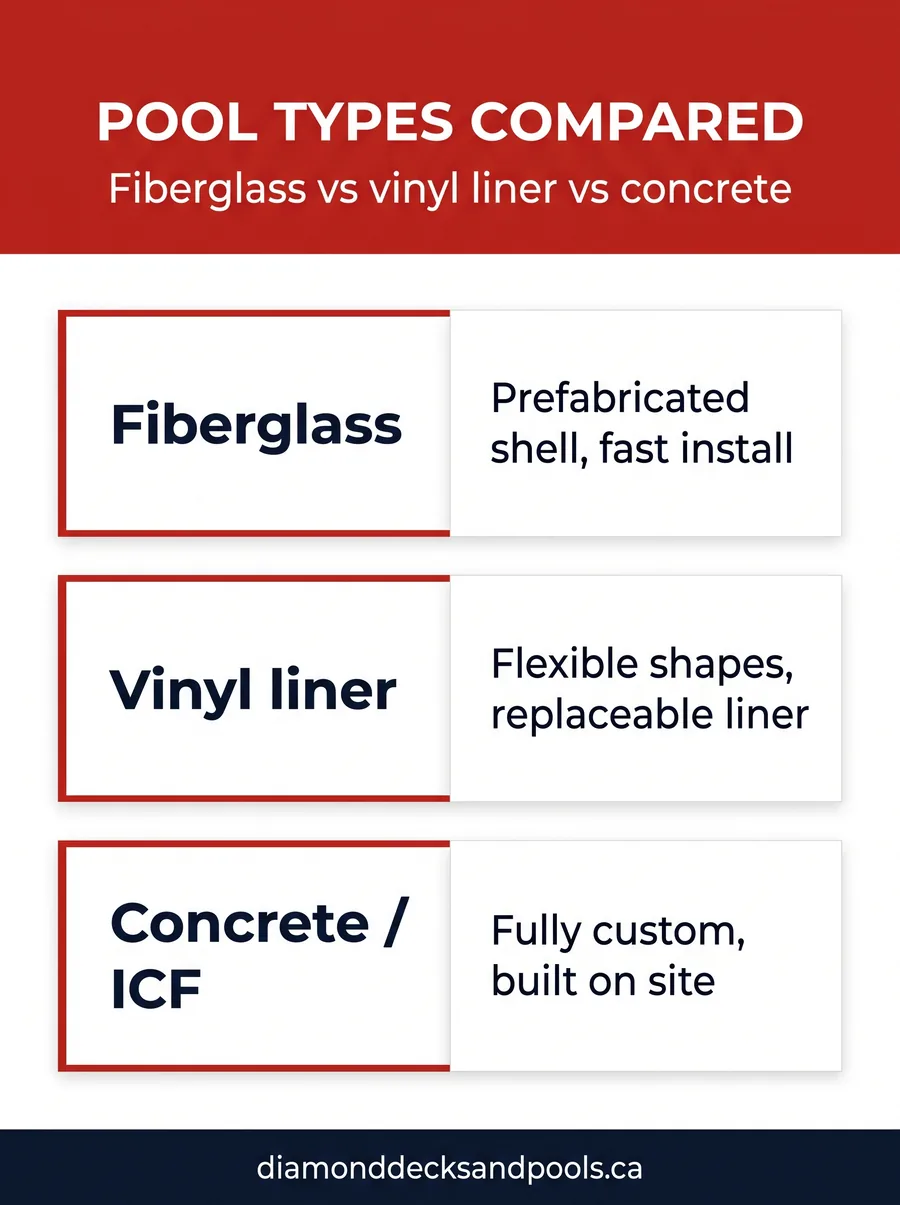
A fiberglass pool arrives on site as a single pre-molded shell, built in a factory and craned into an excavated hole in one piece. A vinyl liner pool is a structural wall system, typically steel or polymer panels, with a custom-cut vinyl membrane stretched over it to hold the water. A concrete pool, including the ICF method we build most often, is formed and poured (or built with insulated concrete forms) directly in the hole, then finished with plaster, pebble, or tile.
That one difference, whether the shell shows up finished or gets built in your yard, is what drives almost every other tradeoff on this list.
Fiberglass vs vinyl liner vs concrete
| Fiberglass | Vinyl liner | Concrete / ICF | |
|---|---|---|---|
| Typical install time | A few weeks once the shell arrives | Several weeks | Often two to three months or more |
| Shape flexibility | Limited to the manufacturer’s molds | Nearly any shape or depth | Fully custom |
| Surface feel | Smooth gelcoat, rarely rough underfoot | Smooth vinyl, can wrinkle over time | Depends on finish, plaster is more textured |
| What wears out first | Gelcoat can fade or stain with age | The liner itself, it is a replaceable part | Plaster or finish can need resurfacing |
| Routine maintenance | Generally the lowest of the three | Moderate, plus periodic liner checks | Generally the highest, more surface to manage |
| Best fit | Homeowners who want to swim, not maintain | Budget-conscious builds or unusual lot shapes | A specific look or a pool built to last decades |
None of these figures are quotes. Every yard has its own access, soil, and grading conditions, and those change the number more than the pool type does.
A note on cost: pool pricing swings widely based on lot access, excavation conditions, decking, and the equipment package you choose, so it is not something a blog post can responsibly quote. Diamond Decks & Pools walks every project through a full scope and site visit before giving you a real number.
How each one is actually built
Fiberglass starts somewhere else entirely. The shell is molded and cured at a factory, trucked to your property, and lowered into a prepared excavation by crane in a single piece. Because the shell already exists, weather delays and forming errors mostly disappear, which is the main reason fiberglass builds move faster than the other two.
Vinyl liner pools build the structure first, usually panel walls set on a base, then stretch a custom vinyl membrane over the entire interior. The liner is doing the actual job of holding water. It is also the part most likely to need attention over the pool’s life, since it is a manufactured product with a service life rather than a permanent surface.
Concrete and ICF pools are built in place from the ground up: forms go in, concrete gets poured or the insulated forms get filled, and the whole shell cures before any finish goes on. That sequence is why concrete builds take the longest. Nothing can happen until the previous step has properly cured, and Ontario’s shoulder-season weather can stretch that timeline further.
People often ask: can you switch pool types later?
Not without essentially starting over. A vinyl liner can be replaced on its own schedule without touching the wall structure, but converting a vinyl liner pool into a fiberglass or concrete one means removing what is there and rebuilding from the excavation up. If you are choosing now, choose for how you actually want to use and maintain the pool ten years from now, not just for the install price today.
Which one fits which backyard
If your yard is a standard rectangular shape and you want to be swimming as early in the season as possible, fiberglass is usually the shortest path there, and it is the type we get the fewest maintenance calls about years later.
If your lot is an unusual shape, has a tight access point a crane cannot reach, or you want a specific depth profile like a tanning ledge built into an odd corner, vinyl liner or concrete give you room to design around the property instead of picking the closest-fitting factory mold.
If you want a pool that reads as a permanent architectural feature, with a specific tile line, a vanishing edge, or an integrated spa, concrete is generally the only one of the three that gets you there exactly as drawn. It costs you build time and ongoing upkeep. That is the tradeoff, and most people who choose concrete already know it going in.
What Ontario winters change about the decision
Every inground pool in the GTA goes through the same yearly cycle: a full close in the fall and a full open in the spring, and every pool type handles freeze-thaw differently. Fiberglass shells flex slightly with ground movement, which is part of why they tend to shrug off frost heave better than a rigid structure. Concrete and vinyl liner pools can both be built to handle Ontario winters properly, but the winterization steps and the water level management matter more for them, and skipping a proper close is where most freeze damage on any pool type actually starts.
Pool fencing and enclosure rules are also worth planning for before you dig, not after. Most Ontario municipalities regulate pool enclosures under their own pool fence bylaw, and requirements vary by city, so confirm the current rule for your address with your local building department before finalizing a fence or gate plan. The Lifesaving Society’s water safety resources are also a useful starting point for thinking through layout and supervision around a new pool.
Good to know: this article is general information, not a project spec. Pool enclosure and permit rules vary by municipality and change over time, and pricing depends on your specific site. Confirm current requirements with your local building department and get a written, site-specific quote before you budget. Diamond Decks & Pools is not responsible for decisions made solely on the basis of this article.
Diamond Decks & Pools builds fiberglass, vinyl liner, and concrete pools across Vaughan, Richmond Hill, Markham, and Aurora. If you are still deciding between the three, a site visit will tell you more than any comparison chart, and it is free.
Download the free quick guide
A short checklist to help you weigh fiberglass, vinyl liner, and concrete before your first consultation.
Frequently asked questions
How long does each pool type actually last?
All three can last decades when they are built correctly and maintained on schedule, but they age differently. A fiberglass shell’s structure typically outlasts its gelcoat finish, which can fade or need refinishing well before the shell itself is a problem. A vinyl liner is the part with the shortest individual service life of anything in the build, and it is designed to be replaced on its own without touching the wall structure underneath. Concrete shells are extremely durable structurally, but the plaster or pebble finish on the surface is what typically needs attention first, often through resurfacing rather than replacement. Ask any contractor for their real-world experience with each type in your specific climate before assuming a single number applies.
Does a vinyl liner pool cost less to maintain than fiberglass?
Day to day chemical maintenance is fairly similar across all three types, since it depends more on your filtration system and how consistently you test the water than on the shell material. Where vinyl liner maintenance tends to add up is the liner itself: sharp objects, sustained sun exposure, and age can all shorten its life, and replacing it is a planned expense that fiberglass and concrete owners simply do not face in the same way. Ask your contractor what a typical liner’s service life looks like in your specific setup before comparing long-term costs.
The bottom line
If you want the fastest build and the least upkeep, look at fiberglass first. If your lot is an unusual shape or your budget needs flexibility, vinyl liner deserves a serious look. If you are building the yard you plan to stay in for good, concrete gives you the most room to design it exactly as you picture it. Talk to Diamond Decks & Pools about which one actually fits your site through our contact page or call (289) 552-1335.
