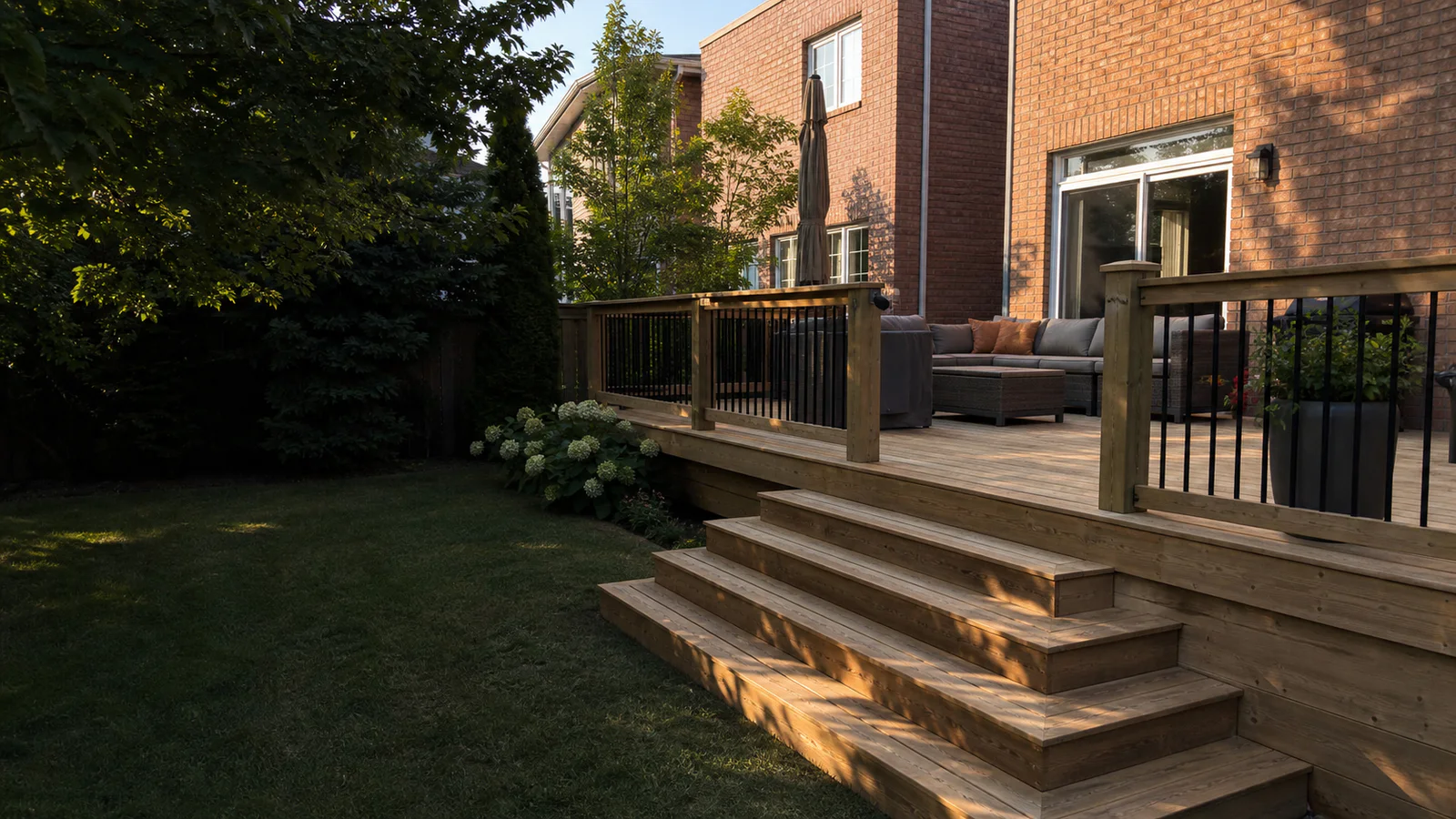
Custom pressure-treated wood deck with broad stairs and black railing behind a Greater Toronto Area brick home

PRESSURE-TREATED DECK BUILDERS IN TORONTO & THE GTA

Pressure-Treated Decks Built for Value and Everyday Life

Custom wood decks that make smart use of budget, with careful board selection, structural detailing, and a design that belongs with your home.


Get a Free Deck Quote See What Matters
wsib insured
licensed and insured
transparent pricing
built for ontario climate
10 year workmanship
5 star rated

PRACTICAL DOES NOT HAVE TO LOOK BASIC

A Better Pressure-Treated Deck Starts Before the First Board

Pressure-treated lumber remains one of the most practical ways to create a real-wood deck. It can deliver generous space and useful features at an approachable initial cost, but the result depends on more than choosing “brown treated” boards at the lumber yard.

Treatment category, board condition, structural design, drainage, fastener compatibility, finish timing, stairs, railings, and the way the deck meets the house all matter. Diamond Decks & Pools brings those decisions together into one clear project.

Get a Free Deck Quote

Surface and Structure
Use the right treated product for its exposure and role.

Drying and Finish
Plan colour care around actual board moisture and product directions.

Complete Backyard
Coordinate stairs, paths, grade, lighting, and future features.

WHY HOMEOWNERS CHOOSE TREATED WOOD

More Usable Space for the Investment

A well-planned pressure-treated deck can prioritize size, function, and natural wood without losing design discipline.

MATERIAL CHOICES CONTINUE BELOW THE SURFACE

Specify the Lumber, Exposure, and Connections

Pressure treatment helps protect wood against decay and insects, but not every treated product is intended for every exposure. Above-ground components, ground-contact conditions, cut ends, and water-trapping details require deliberate choices.

During Design and Construction

  • Match treated products to above-ground, ground-contact, and structural uses.
  • Use compatible corrosion-resistant fasteners, connectors, and flashing.
  • Plan drainage and airflow around joists, beams, ledgers, stairs, and skirting.
  • Select boards for crown, knots, checking, and the visible areas of the deck.

After Installation

  • Allow new lumber to reach the condition required by the selected finish.
  • Keep leaves, soil, and planters from holding moisture against the wood.
  • Clean with a wood-appropriate method and avoid aggressive pressure.
  • Inspect boards, guards, stairs, connections, and drainage as part of routine care.

COMPARE INITIAL COST WITH ONGOING PRIORITIES

Pressure-Treated Wood or Composite?

The surface materials can create very different ownership experiences even when they share a similar layout and frame.

Pressure-Treated Wood

  • Lower initial material cost in many deck designs.
  • Authentic wood grain with knots and board-to-board variation.
  • Can be stained when the wood and selected product are ready.
  • Requires recurring cleaning, inspection, and finish decisions.
  • May check, shrink, splinter, or move as exterior wood changes.

Best fit: homeowners who want real wood, practical value, and are comfortable with ongoing care.

Composite Decking

  • Higher initial material cost in many comparable projects.
  • More consistent colour and texture across the deck surface.
  • No recurring stain or oil cycle for colour retention.
  • Still needs cleaning, drainage, and product-specific installation.
  • Brand, collection, colour, heat, traction, and warranty terms require comparison.

Best fit: homeowners who prioritize a more consistent surface and a simpler colour-care routine.

WHAT SHAPES THE ESTIMATE

Value Comes From a Clear, Complete Scope

The decking is only one part of the investment. Height, foundations, framing, access, railings, stairs, and site work can change the project more than the surface-board price alone.

Request a Detailed Estimate

Deck Design

Size, levels, board pattern, stairs, railings, benches, privacy features, lighting, skirting, and future use.

Property Conditions

Access, demolition, grade, foundations, drainage, attachment, utilities, permits, and integration with hardscape and planting.

Our approach: price the complete installed deck and make optional features visible, so value can be judged by the space you will actually receive.

OUR PROCESS

A Straightforward Path to a Better-Built Deck

One coordinated team connects the property review, design, approvals, construction, and care guidance.

PRESSURE-TREATED DECK FAQS

Useful Answers Before You Build

Pressure-treated wood is familiar, but a few technical and maintenance decisions make a meaningful difference.

Ask About Your Deck
Pressure-treated wood has preservative forced into the material to improve resistance to fungal decay and destructive insects. Residential products in Canada may use preservatives such as alkaline copper quaternary or copper azole. Treatment does not make a deck maintenance-free, and the product must still be selected for its intended exposure.
Cost depends on size, height, foundations, framing, site access, demolition, stairs, railings, lighting, privacy features, finish, drainage, and permit requirements. Pressure-treated decking is often one of the more approachable initial material choices, but a useful estimate must include the complete structure and site scope.
There is no reliable calendar date that applies to every board. New treated lumber can contain significant moisture, and exposure varies by property. The wood should meet the selected finish manufacturer’s preparation and moisture requirements before coating. We discuss finish timing based on the actual material and product rather than promising a fixed wait.
A suitable exterior finish or water-repellent system can help manage surface wetting, colour, and checking, but the correct product and preparation matter. Coatings create future maintenance and should be chosen for the appearance and reapplication cycle you are prepared to maintain.
Exterior wood gains and loses moisture as conditions change. Checks, shrinkage, movement, and some surface variation are normal possibilities, especially as wetter new boards dry. Board selection, spacing, fastening, ventilation, and finish can influence the result but cannot make real wood dimensionally static.
Health Canada permits registered treated-wood products for residential uses when they are used according to their labels and handled appropriately. Construction debris and sawdust should be cleaned up and disposed of as directed, and treated wood should never be burned.
It depends on the priorities. Treated wood often leads on initial value. Cedar is commonly selected for warmer natural appearance and grade options. Composite offers a more consistent engineered surface and no recurring stain cycle for colour retention. The structure, maintenance expectations, and complete installed cost should be compared together.
Permit and zoning requirements depend on the municipality, deck size, height, attachment, location, and property conditions. Attached, elevated, or larger decks commonly require drawings and review. Conservation authority, tree, ravine, or other approvals may also apply on some properties.

Review Health Canada guidance for treated wood and the current City of Toronto deck and porch permit guide. Properties in a regulated area may also need TRCA review. Requirements and product labels can change.

diamond decks and pools landscaping

START PLANNING YOUR DECK

Get Your Free Pressure-Treated Deck Estimate

Tell us about your property, the size and features you are considering, and how you want the wood to look over time. We will help you plan the complete deck without pressure.

01

No Obligation

Ask questions and compare practical options without sales pressure.

02

Complete Scope

Understand framing, stairs, railings, finish choices, drainage, and site work.

03

Detailed Estimate

See the core deck and useful options clearly before construction begins.