 Decks
Decks Pools
Pools Stonework
 Outdoor Structures
 Outdoor Living
CUSTOM BACKYARD COURTS
Backyard Sports Courts
After-school practice. A weekend doubles match. One more game before dinner. Build a court around the way your family plays.

CUSTOM BACKYARD COURTS
After-school practice. A weekend doubles match. One more game before dinner. Build a court around the way your family plays.
MORE TIME FOR THE GAMES YOU LOVE
A backyard court makes it easier to practise a shot, invite friends over or spend an active hour together without leaving home. The right design also leaves room for the rest of your life outside.
Diamond Decks & Pools plans and builds residential sports courts as part of a complete outdoor space. We bring the playing area, base preparation, drainage, surfacing and surrounding landscape into one coordinated plan.
Start with basketball, pickleball or a multi-sport layout. We will help you work through the available space, the games that matter most and the details that make the court comfortable to live beside.
Explore our outdoor living services to connect the court with the rest of your backyard.
CHOOSE THE GAME FIRST
A dedicated court and a shared play space solve different needs. We start with how you will actually use it.
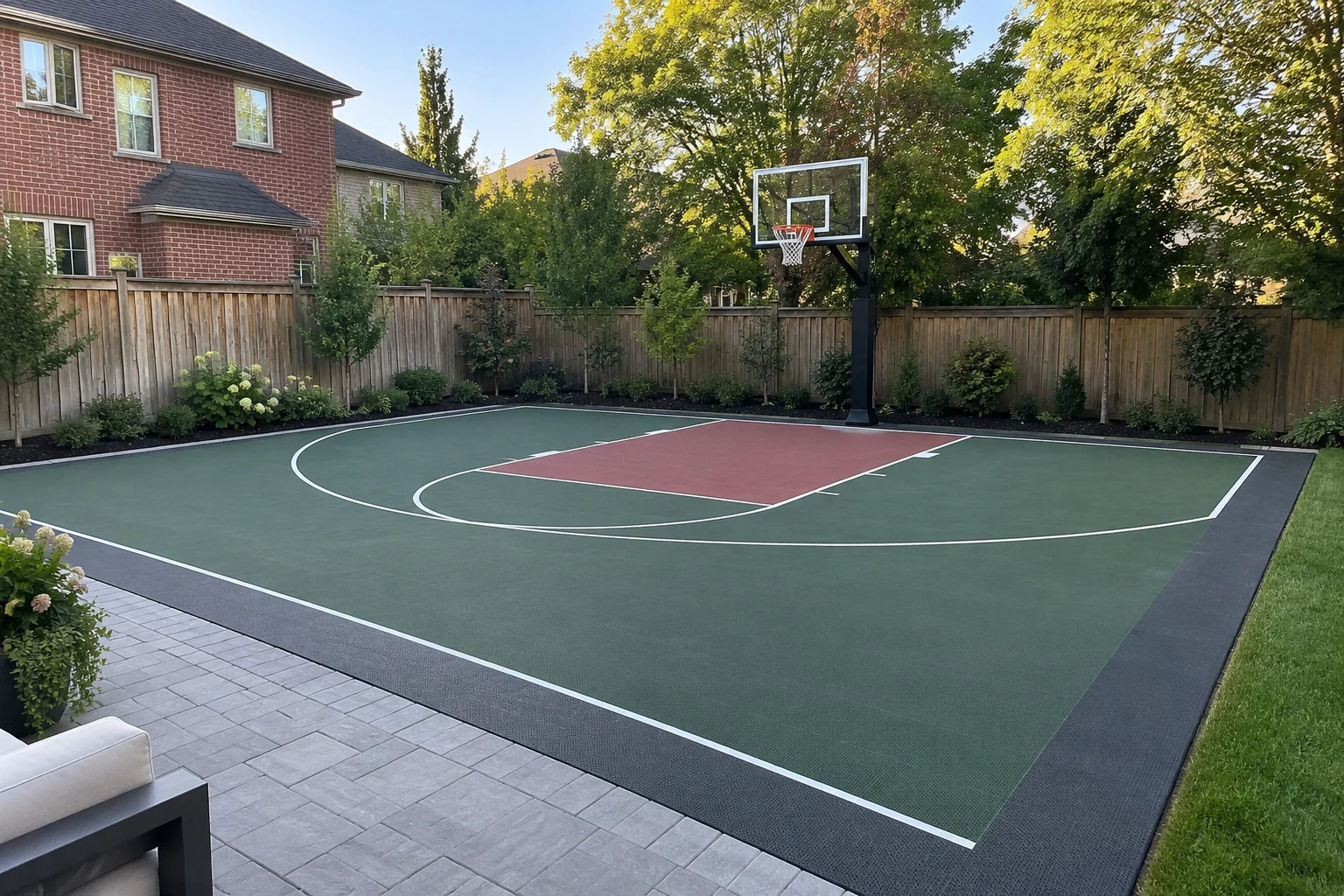
From a focused shooting area to a generous half-court, create space for daily practice and friendly games.
Plan around: hoop position, backboard overhang, clear playing space, ball containment and the distance from windows or parking.
Custom recreational dimensions can suit a backyard without pretending to be a regulation court.
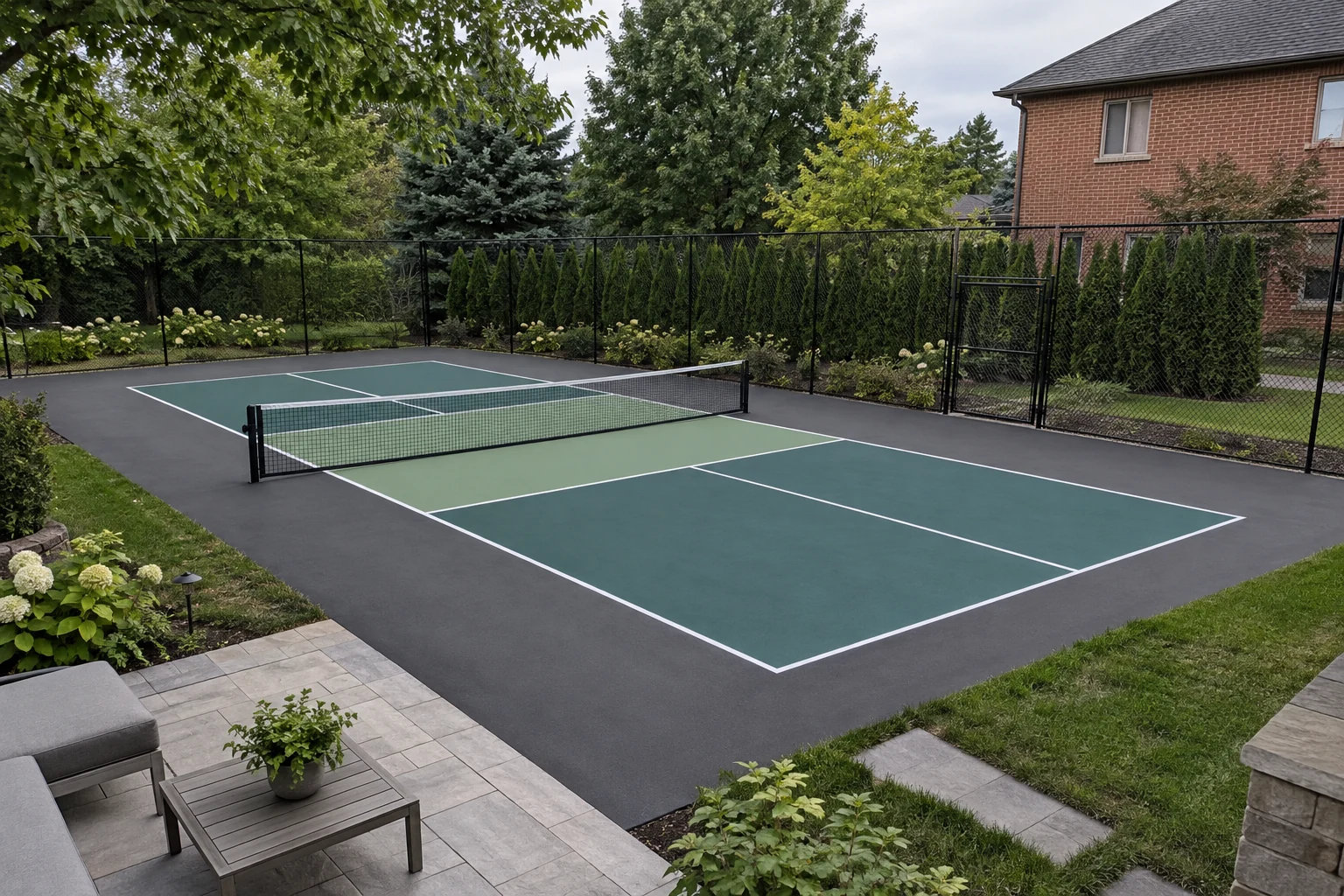
A dedicated layout gives doubles games and regular practice a permanent home, with clear lines and a purpose-selected surface.
Plan around: the full court footprint, space beyond the lines, net placement, consistent ball response and nearby homes.
The painted rectangle is only part of the space you need. Player movement belongs in the plan from day one.
Keep one area useful for different ages and interests with a considered mix of games, equipment and line markings.
Plan around: a primary sport, a compatible surface, removable nets, uncluttered line colours and equipment storage.
We explain the compromises before combining games, rather than fitting every possible marking onto one court.
Thinking about tennis? Tell us early. A full tennis court needs substantially more room, including space beyond the playing lines. We can assess whether that scale makes sense for your property.
MULTI-USE BACKYARD COURTS
Pickleball with friends, tennis practice on the weekend and a few baskets after dinner. A multi-use sports court gives different interests a place in the same backyard.
We plan the layout around your main game first, then work through compatible sports, contrasting line colours and removable or adjustable equipment. The goal is an easy changeover, not a crowded surface that is difficult to read.
A tennis-sized playing area may accommodate a pickleball layout with separate markings and suitable net arrangements. Full-size tennis needs substantially more space than pickleball. On smaller lots, short-court tennis can be a recreational option, but it is not a substitute for a regulation tennis court.
Position a hoop to support shooting or half-court play without placing its support in another game’s playing or run-off area. Removable nets need a convenient storage location so switching from racquet games to basketball stays practical.
Suitable adjustable net equipment can make room for badminton and recreational volleyball where space allows. We check net heights, post locations, surface suitability and clearances for the intended games. A shared hard court is a recreational compromise, not a sand volleyball court or a competition facility.
WHAT HAPPENS BELOW THE SURFACE MATTERS
A good-looking surface cannot correct a moving base or water with nowhere to go. Ontario’s freeze-thaw conditions make the underlying construction an important part of the decision.
On a sloping lot, retaining walls and grade changes may be part of the wider design, not an afterthought added around the court.
COMPARE THE COMPLETE SYSTEM
The right choice depends on your main sport, the base, maintenance preferences and the specific product.
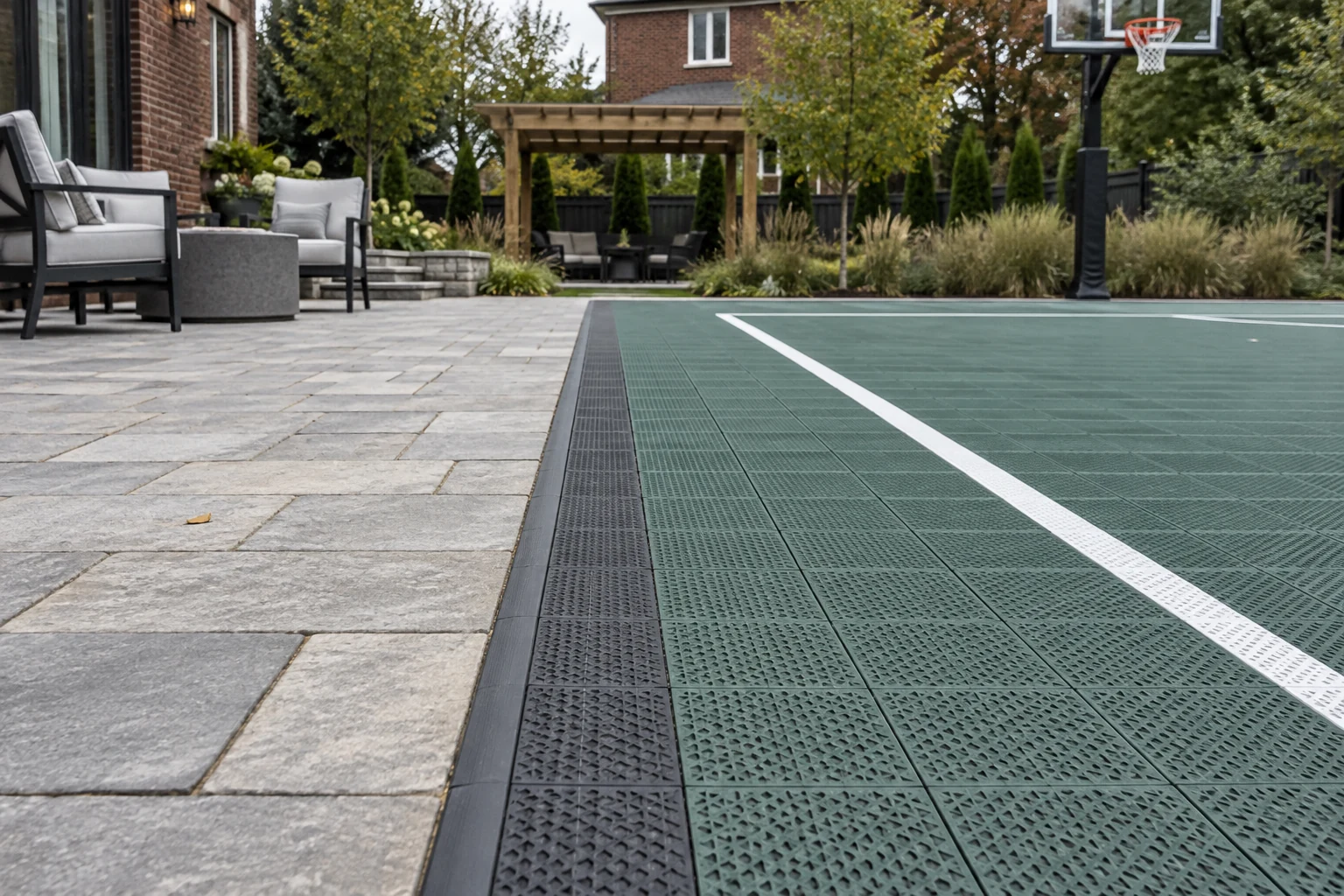
Interlocking outdoor court tiles offer colour flexibility and replaceable sections. Their feel and ball response depend on the tile design and what supports it.
Important: water passing through a tile does not make the base underneath permeable or remove the need for drainage.
An acrylic sport coating creates a continuous textured playing surface over a suitable prepared base, commonly concrete or asphalt.
Important: a coating does not repair underlying structural movement. Existing slabs need assessment before reuse.
We compare the proposed base and finish together. Ask us which court surface suits your backyard.
A PLACE TO PLAY, A BACKYARD TO ENJOY
The best location is not always the largest empty rectangle. We consider how people reach the court, where spectators sit and how the space feels from inside your home.
Based in Bradford, Diamond serves Toronto, York Region and surrounding communities. See our local service areas to start planning near you.
Connect a stone patio seating area or pergola for shade without placing furniture or posts in the run-off area. Keep everyday routes outside active play.
Plan outdoor lighting for visibility without spill into neighbouring windows. Court-rated ball-stop fencing may be needed; a decorative backyard fence is not automatically a suitable substitute.
Consider play hours, pickleball impact noise and the distance to neighbouring living spaces before choosing a location. Garden planting can soften the view, but hedges alone should not be treated as effective acoustic control.
BEFORE THE FIRST GAME
Space, budget and the right surface are usually the first decisions. Here are useful starting points for your conversation with Diamond.
The marked playing court is 20 by 44 feet, but that is not the full installation footprint. USA Pickleball’s published guidance recommends a 34-by-64-foot playing surface for new construction, approximately 10.4 by 19.5 metres, including space beyond the lines. Fencing, paths, equipment, setbacks and landscaping may need additional room.
We check the usable area before recommending a layout. A smaller recreational practice space should not be presented as a regulation pickleball court.
The price depends on the overall footprint, access, excavation, ground conditions, drainage, base system, surface and equipment. Fencing, lighting, retaining work and surrounding landscape can materially change the total.
A useful estimate separates court construction from optional features and explains the assumptions. Send us your location, approximate space and preferred games so we can discuss a realistic scope.
Often, provided the full layout and surface are suitable for both. We plan distinct line colours, net storage or removal, hoop position and clear space for players. If pickleball is the priority, the selected surface’s pickleball performance should guide the choice rather than colour alone.
Requirements depend on the municipality, property and scope. Confirm applicable zoning, setbacks, lot coverage, grading and drainage conditions, as well as rules affecting fencing, retaining walls, lighting and noise. Conservation restrictions or easements may also affect a site. We identify what needs review before the layout is final; a court is not automatically exempt because it is in a backyard.
Sometimes. Its size, slope, surface condition, cracks, movement and drainage need assessment against the proposed court system. An old patio or driveway may not provide a suitable base, and covering it with tiles does not correct settlement or inadequate drainage.
The schedule depends on site preparation, approvals where needed, base construction and curing, weather, material availability and optional features. We outline the sequence for your project once its scope is defined. Installing the finish is only one stage of a complete court build.
Clear leaves and debris, keep drainage routes open and inspect the surface, edges, lines, nets and hoop hardware. Follow the selected manufacturer’s cleaning and winter-care instructions. Avoid unapproved de-icers, sharp tools or heavy equipment that could damage the finish. Acrylic coatings and modular tiles have different maintenance and replacement needs.
Diamond offers a five-year workmanship warranty and carries WSIB coverage and $5 million in liability insurance. Product coverage depends on the selected court system and equipment; the applicable terms should be confirmed in your proposal. Read our workmanship and manufacturer warranty information.
YOUR BACKYARD. YOUR HOME COURT.
Tell us where you live, which games you love and roughly how much space you have. We will help turn those starting points into a practical backyard court plan.
A few property photos and an approximate budget are helpful, but you do not need a finished design to start.
Prefer to talk?
(289) 552-1335
Five-year workmanship warranty. WSIB coverage. $5 million liability insurance.